
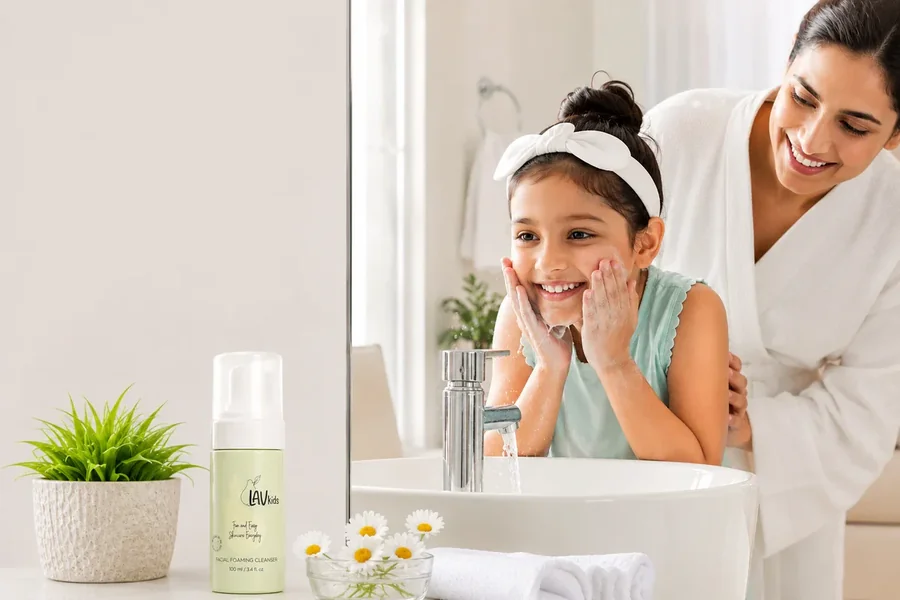
If you have teenagers at home, you must be aware of the struggles related to their skin like popping up a pimple right before an important event etc; it surely seems very overwhelming. Reading furthur, one shall get to know about the skin issues faced by the teenagers, their root cause and the strategies on how to overcome them.
When we go through puberty our hormones are pumped high, switching on sebaceous glands for the first time and causing oil production levels to sky-rocket. In India, puberty starts for girls aged 10-12, and for boys aged 11-13, usually 1 to 2 years before it shows up on their faces.
Oil production levels hit a high during ages 15-17 (girls) and 16-19 (boys), which is when many experience the worst outbreaks. In parallel, there is a massive shift happening to our skin microbiome – Cutibacterium acnes (the main culprit when it comes to breakouts) becomes the single most prevalent organism on your face. It is because this bacteria grows in the newly oily environment.
Other than hormonal changes, it could be due to the food habits and sleep cycle. Food habits must be controlled such as limiting the consumption of high glycemic index foods, dairy products etc. The sleep cycle must be fixed, ensuring 8 hours of sleep. Avoid stress and ensure proper hydration.
What is Puberty?
Puberty is the process of physical maturation. This is where an individual reaches sexual maturity and becomes capable of reproduction. Androgen receptors and the GnRH hormone step into the limelight in terms of changes that happen to the skin during puberty. The hormone triggers a sequence of signals from reproductive glands in males and females to reawaken resting hormones. This phenomena causes a temporary spike in sebum production.
Skin and its Types
Skin is the largest organ of the human body which protects the internal organs from infection and germs. It separates the internal organs from the external environment. The nerves present in the skin helps in feeling the sensations. Skin is responsible for maintaining the homeostasis of the body.
It mainly consists of three layers
- the epidermis
- the dermis
- the subcutaneous layer
Understanding the skin type
Understanding the skin type before choosing any skin care product is a very essential step. Various types of skin are as follows:
- Oily Skin: Appears shiny, usually prone to acne
- Dry Skin: It can be flaky, rough and may feel tight after washing
- Combination Skin: Oily in the T-zone (forehead, nose, chin) and dry elsewhere
- Normal Skin: Skin microbiome is balanced neither too oily nor too dry
- Sensitive Skin: It usually gets irritated easily and is more prone to rashes
It is quite crucial that one should choose and use the skincare product according to their skin type. This approach totally helps to avoid negative consequences.
How does skin change during Puberty?
The androgen receptor and gonadotropin-releasing hormone (GnRH) totally takes the stage during this phase. These hormones start sending signals to the reproductive organs of both the male as well as female. It is done to stimulate the dormant hormones. Take GnRH, for example. It is responsible for signalling the ovaries to kickstart the production of estrogen.
Once released, the hormone reaches the bloodstream, these put the sebaceous glands into action. Consequently, the natural skin oil (sebum) travels up into the hair follicles where each of them are equipped with an oil gland. This temporary rise in androgen hormones during puberty plays a major role in common issues like acne, heightened skin oiliness etc in teenagers.
Types of Acne
Whiteheads
These are non-inflammatory white dots caused by pores filled with oil and covered by layers of skin (usually are skin colored) and they merge with the original skin.
Blackheads
Hair follicles clogged with excess oil and dead skin and overtime oxidation cause them to turn black in color. These are non-inflammatory types of acne.
Papules, nodules or pustules
These are solid bumps that contain pus and ultimately become larger painful lumps deeper under the skin.
Cysts
Usually painful presents deep in the skin and pus-filled acne.
During puberty, the brain releases hormones that totally trigger the production of estrogen and testosterone. It stimulates sebaceous glands to produce excess skin oil and cause teenage acne.
AM- PM Skin Care Routine
The only skin care steps and products one need to incorporate into the their regimen are as follows:
Morning
Cleanser, Moisturiser and sunscreen
Evening
Face Cleanser, Moisturizer
The standard skin care Regimen
Morning
Cleanser
Incorporate a mild, gentle and sulfate free pimple clear best face wash. The pH must be optimum (5.5). In case of acne prone skin, use a cleanser containing salicylic acid (generally 0.5-2%). Avoid cleansers with heavy fragrances. Use it twice a day.
Moisturiser
It might come as a shock to you, but even the oiliest of us skin types need moisture. If the skin barrier has dehydrated, the skin reacts and starts to produce even more oil through a feedback process known as transepidermal water loss in order to compensate for the dehydration.
Oily skin types should apply a lightweight non-comedogenic gel or water based product that is packed full of hydrating ingredients such as Hyaluronic Acid and Niacinamide without any pore blocking properties. For the drier skin types, apply ceramide based moisturizers.
Sunscreen
Always follow up with a broad spectrum sunscreen with SPF 30 or more, don’t forget to apply it even if you are mostly indoor.
Evening
Cleanser
Use an oil based cleanser to remove makeup, dirt and skincare. Then follow up with a water based gentle cleanser for teenagers.
Moisturiser
Use a nourishing and hydrating face moisturiser to repair the skin barrier.
Social media has literally convinced teenagers at a very vast level that they need 10-step routines, multiple serums, essences, toners as well as expensive skincare products. The reality for attaining and maintaining better skin during teenage years is the opposite: simplicity is the key.
The adolescent skin barrier is not fully developing when one is in their teenage years. By using harsh exfoliants and too many products totally disrupts barrier function. It also causes irritation as well as worsens the problems they are trying to solve.
- Do not use too many products or actives at once.
- Using a few targeted products works better than using dozens of other creams and serums or actives.